Catch and Release: Best Practices for Conservation
Modern angling is increasingly focused on the future. Catch and release is more than simply letting a fish go; it is the commitment to ensuring that the fish survives the encounter, recovers fully, and can go on to spawn, contributing to the health of the fishery. Poor handling techniques can lead to delayed mortality, defeating the purpose of releasing the fish entirely. This guide outlines the essential practices for responsible catch and release.
The Right Gear for Conservation
Successful catch and release begins before you even cast a line. The equipment you choose plays a massive role in minimizing harm to the fish.
- Barbless Hooks: Pinching down the barb on your hooks with pliers, or buying factory barbless hooks, is the single most impactful change an angler can make. Barbless hooks back out cleanly and quickly, drastically reducing unhooking time and tissue damage.
- Rubberized Nets: Traditional knotted nylon nets strip the protective slime coat off fish, leaving them vulnerable to fungal infections. Soft, rubberized nets protect the slime coat and prevent fins from splitting.
- Appropriate Tackle: Using ultra-light gear for large fish might seem sporting, but playing a fish to utter exhaustion drastically reduces its chances of survival. Use gear heavy enough to land the fish relatively quickly.
Proper Handling Techniques
Once a fish is in the net, how you handle it determines its fate. Fish are adapted to a weightless aquatic environment; bringing them into the air and gravity causes immense stress.
Wet Hands Are Mandatory
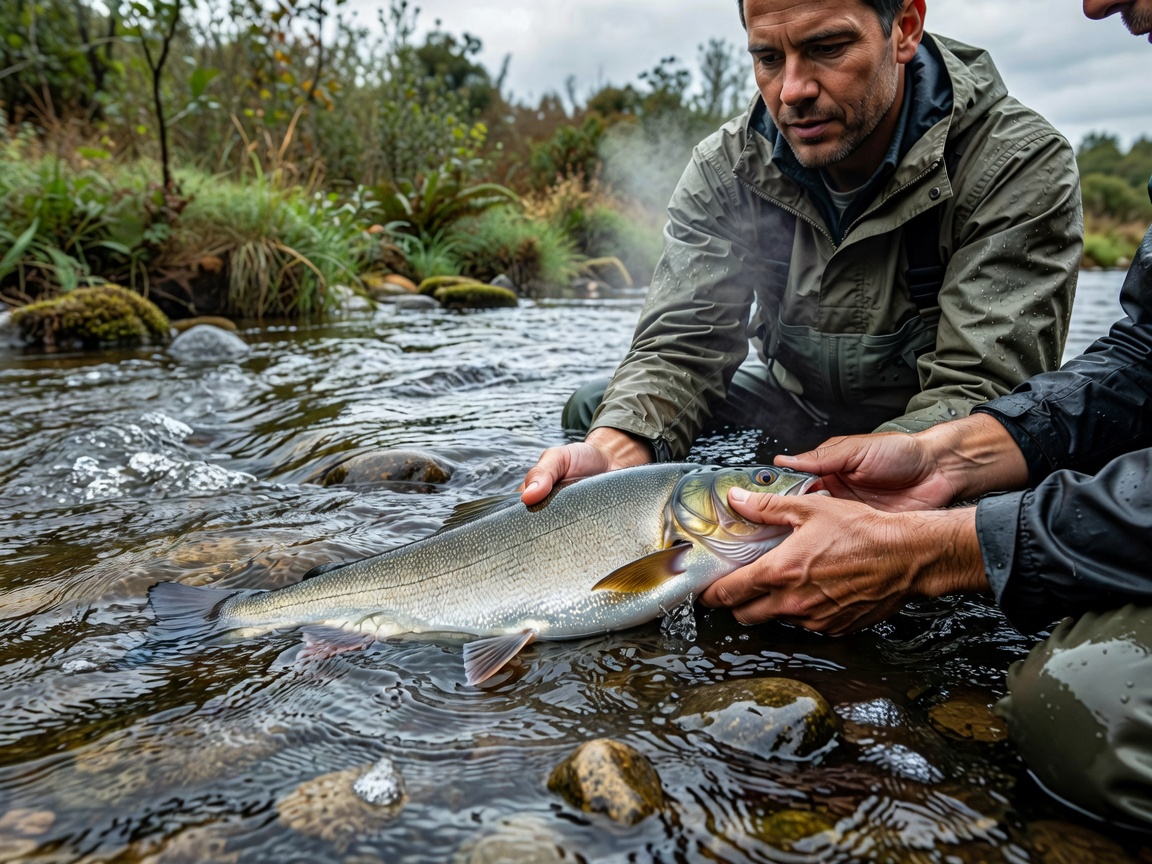
Never touch a fish with dry hands, gloves, or towels. Dry surfaces will strip the protective slime coat instantly. Always submerge your hands in the water before touching the fish.
Keep Them in the Water
The goal is to keep the fish's gills submerged as much as possible. A good rule of thumb is that fish can hold their breath in the air roughly as long as you can hold your breath underwater. Try to unhook the fish while it is still in the net, submerged in the water. If you must lift it for a photograph, keep it low over the water, support its belly horizontally, and limit air exposure to 5-10 seconds maximum.
Avoid the Gills and Squeezing
Never place your fingers inside the gill plates. Gills are incredibly fragile respiratory organs; any damage to them is almost always fatal. Additionally, avoid squeezing the fish's midsection, as this can easily rupture internal organs.
Reviving the Fish
After a fight, a fish will be exhausted and oxygen-depleted. Simply tossing it back into the water can be a death sentence, especially in fast currents or warm water.
To revive a fish, hold it gently by the tail with one hand, supporting its belly with the other. Face the fish upstream into the current so water naturally flows into its mouth and over its gills. Do not forcefully pump the fish back and forth; simply hold it steady. You will feel the fish begin to regain its strength and kick its tail. Let it swim out of your hands under its own power.
Special Considerations
During the heat of summer, water temperatures can rise to dangerous levels (particularly for cold-water species like trout). When water temperatures exceed 68°F (20°C), oxygen levels drop significantly, and the stress of being caught can be fatal even with perfect handling. Ethical anglers monitor water temperatures and choose to fish early in the morning, or stop fishing entirely until conditions improve.
Conclusion
As anglers, we are the stewards of the waters we fish. Adopting rigorous catch and release practices ensures that the thrill of the catch is balanced with deep respect for the resource, preserving vibrant ecosystems for generations to come.